One query instead of
five greps.
cpk scan indexes your codebase with tree-sitter.
Agents query symbols, imports, and dependents through one CLI — at the cost of
a single grep, with the structural detail of reading every file. Plus a local
task board for multi-agent coordination. 100% Open Source.
The discovery tax
Most of an agent's "exploration" cost isn't reading the file it actually needs to change.
It's the four to six grep cycles before that — finding what exists, where it lives, and
what shape it has. cpk scan indexes that once, so agents
replace those greps with a single structured query.
One query instead of five greps
cpk code symbols --name Broadcast returns every match
across backend, frontend, and webhooks — with file paths, line numbers, signatures,
and parent classes. No follow-up reads to figure out what's a class vs a method.
Discovery, not verification
Signatures tell agents what exists. Bodies still need reading to verify
behaviour. cpk code accelerates the first half
of every session — orientation — at near-zero cost.
Atomic Task Pickup
When multiple agents coordinate on a shared board, BEGIN IMMEDIATE
transactions guarantee exclusive pickup — no duplicate work.
The win isn't a flat percentage — it scales with how unfamiliar the code is. Agents
landing in a fresh repo benefit most. Agents working in code they already know save
less. cpk scan --install-hook keeps the index fresh so
the value doesn't decay.
From zero to indexed in 30 seconds
One install, one scan, and your agents query a local index instead of burning tokens on exploration.
Install & Init
npm i -g codepakt
cd your-project && cpk init --name your-project
No Docker. No config. macOS + Linux.
Scan & Hook
cpk scan
cpk scan --install-hook
Tree-sitter parses TS/JS/Python/Go. Incremental updates on every git commit.
Agents Query
cpk code symbols --name X
cpk code dependents --file Y
~200 tokens per query. No server needed for code commands.
Code Intelligence
cpk scan parses your codebase with tree-sitter WASM and indexes
symbols, imports, and dependents into a local SQLite file.
cpk code symbols --name X returns every match — backend, frontend,
webhooks — with file paths, line numbers, signatures, and parent classes in one structured payload.
Works offline. No server needed.
Atomic Task Pickup
BEGIN IMMEDIATE transactions prevent two agents from ever claiming the same task. Zero merge conflicts.
Git Hook Integration
cpk scan --install-hook keeps the index fresh on every commit. Incremental updates in milliseconds.
Live Dashboard
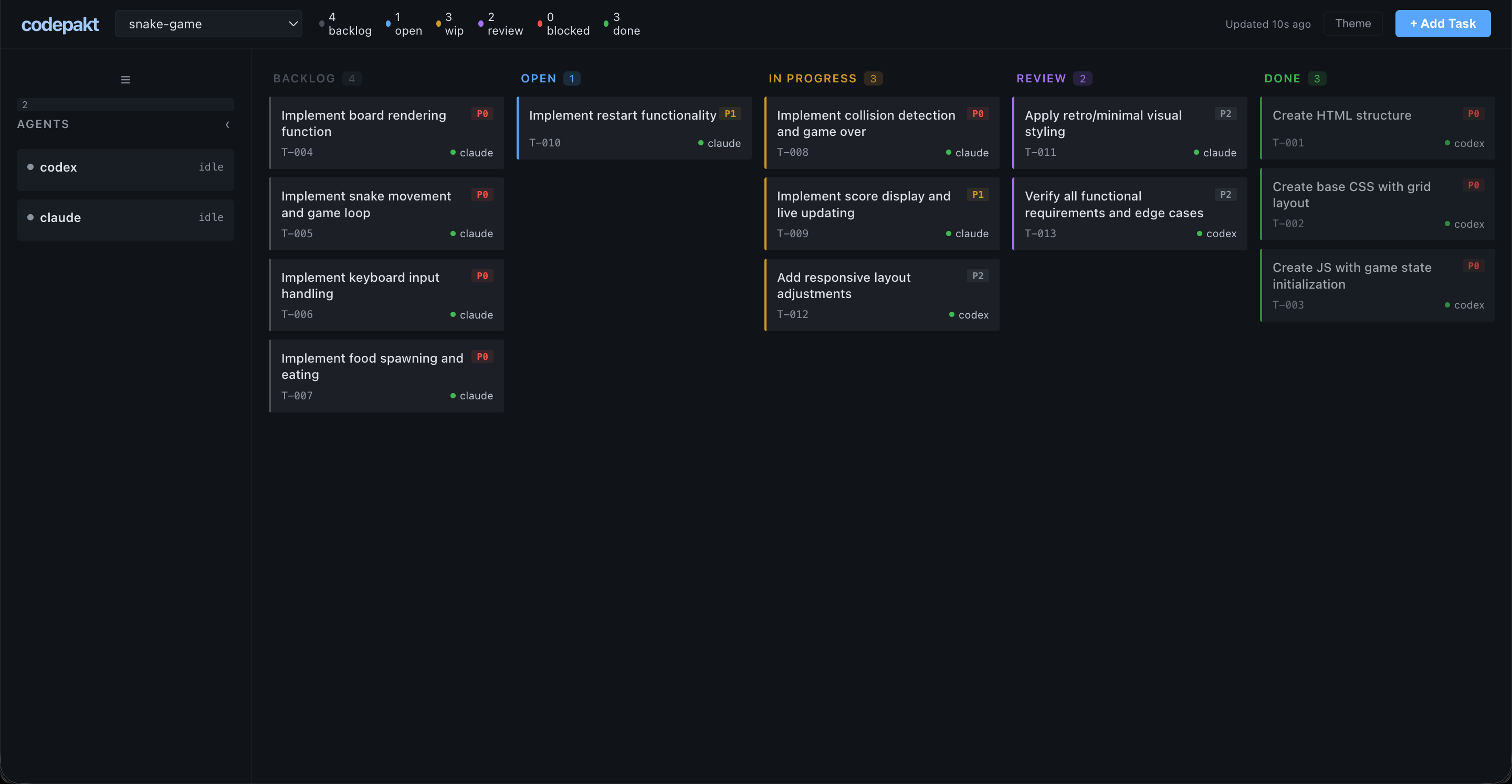
Kanban board with drag-and-drop at localhost:41920 for the task coordination half.
"There is no schedule option for WA campaigns. Use cpk for code intelligence."
One prompt to a Claude Code session on a real production codebase. Here's how the agent
used cpk code to land the fix.
One query, full picture
Returned ~30 symbols across backend, frontend, and webhooks in a single payload —
file paths, line numbers, signatures, and parent classes. The agent identified
scheduleBroadcast, processScheduledBroadcast,
ScheduleBroadcastDialog, and BroadcastActions
— without opening a single file.
Diagnosis from signatures alone
The signatures answered the structural question — "scheduling infra exists" — at zero file-read cost. The agent now knew the bug wasn't missing functionality. It was a UX problem: users couldn't reach the dialog.
Two targeted reads, not five speculative ones
The agent then opened only the two files needed to verify the UX gap:
- •
broadcasts/page.tsx— the wizard + dialog wiring - •
csv-broadcast-wizard.tsx— confirmed the absence of a schedule path
Without the index: 4-6 grep+read cycles across apps/api/,
apps/web/, hooks, and webhooks — each returning raw lines
with no structural context.
"I'd estimate this exploration used ~30-40% fewer tokens than a grep/glob/read approach would have for the same conclusion. The win scales with codebase unfamiliarity — for a known module it'd matter less."
The Open Source Stack
100% Open Source
MIT licensed. SQLite embedded. No Docker required. Install and go.
Generated Coordination Files
cpk generate writes .codepakt/AGENTS.md and
.codepakt/CLAUDE.md with the full command reference — so agents that drop into
the project automatically know what to run.
Team
The people building codepakt.
Ready to index?
Point codepakt at any repo and your agents stop burning tokens on discovery. MIT Licensed.
npm i -g codepakt

cd your-project

cpk init --name your-project

cpk scan

cpk scan --install-hook

cpk code summary